Dimming protocols are often treated as an interchangeable checkbox on a spec sheet, but TRIAC, ELV, 0-10V, and DALI each control light through a fundamentally different mechanism — and confusing them is one of the more common ways a lighting specification runs into trouble on-site.
What you’ll find in this article: how TRIAC, ELV, 0-10V, and DALI dimming each work, where each is typically applied, and how to weigh the tradeoffs when discussing a system with an electrician or architect.
For anyone who advises on lighting rather than installs it, dimming protocols can feel like a language spoken fluently by electricians and haltingly by everyone else. That gap closes quickly once the four major protocols are understood not as arbitrary categories, but as four distinct answers to the same question: how does a controller actually tell a light how bright to be?
TRIAC and ELV: phase-cut dimming
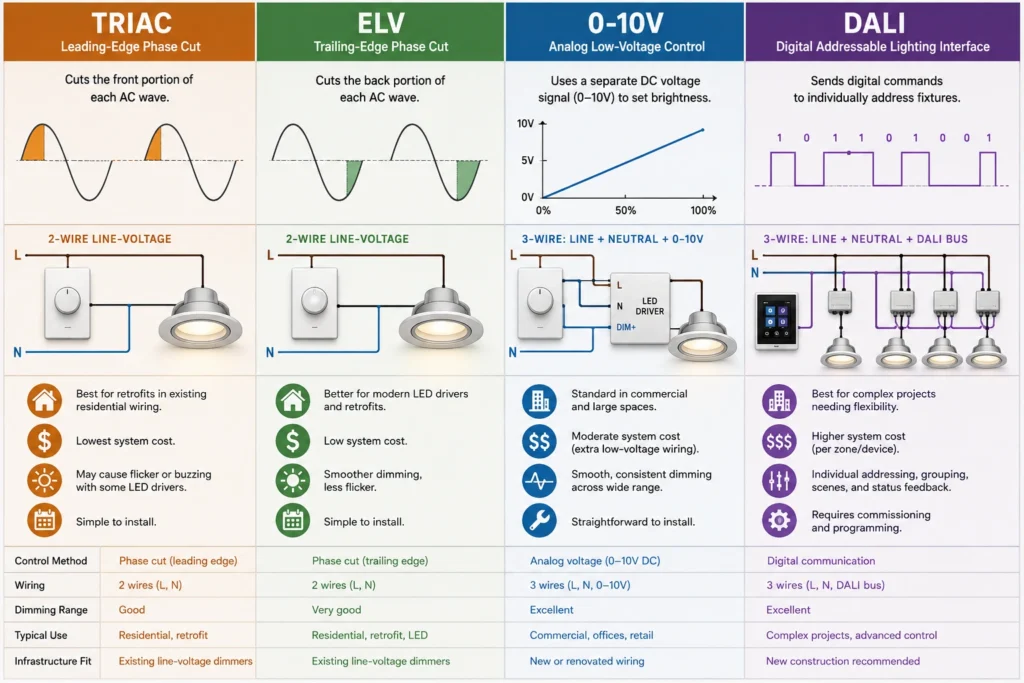
TRIAC and ELV both dim by altering the AC power waveform itself, rather than sending a separate instruction alongside it.
- TRIAC, or leading-edge dimming, cuts the front portion of each AC wave and remains the standard found in most older residential dimmers
- ELV, or trailing-edge dimming, cuts the back portion instead, generally producing smoother results with modern LED drivers and less visible flicker
- Both require only the existing two wires, which makes either an economical option for retrofits
0-10V: analog low-voltage control
0-10V dimming introduces a second, dedicated signal — a DC voltage between zero and ten volts — that runs alongside the main power line to tell the driver how bright to run.
- Ten volts corresponds to full brightness, zero volts to the lowest available level, with a proportional range in between
- The added wiring is a genuine cost, but the payoff is smooth, dependable dimming across a wide range of fixtures
- Widely regarded as the default commercial protocol, from open-plan offices to large-format retail
DALI: digital addressable control
DALI, the Digital Addressable Lighting Interface, departs from both approaches by sending digital commands rather than an analog signal.
- Each fixture carries its own address, allowing individual lights or defined groups to be controlled from a single system
- Communication runs in both directions, so the system can confirm status rather than simply issue instructions
- Capable of scene-setting and zoning complexity that neither phase-cut nor 0-10V dimming can approach
What a specifier should weigh
- Existing infrastructure: a retrofit with line-voltage dimmers already in place will generally favor TRIAC or ELV
- Budget relative to scale: 0-10V remains the practical commercial default, while DALI’s higher per-zone cost is best justified on larger or more intricate installations
- Commissioning time: DALI requires trained setup and address configuration, a labor and schedule consideration as real as the hardware cost itself
A dimming protocol functions less like a preference and more like a language the fixture and its controller must share. Matching that language correctly is what allows a room to dim the way its designer actually intended.